Malawi unveils Mega Farms Legacy Investment Programme to drive agricultural transformation
Malawi has unveiled the Mega Farms Legacy Investment Programme, an ambitious initiative aimed at attracting private-sector investment into commercial agriculture, agro-processing and value addition as the country seeks to transform its agri-food system.
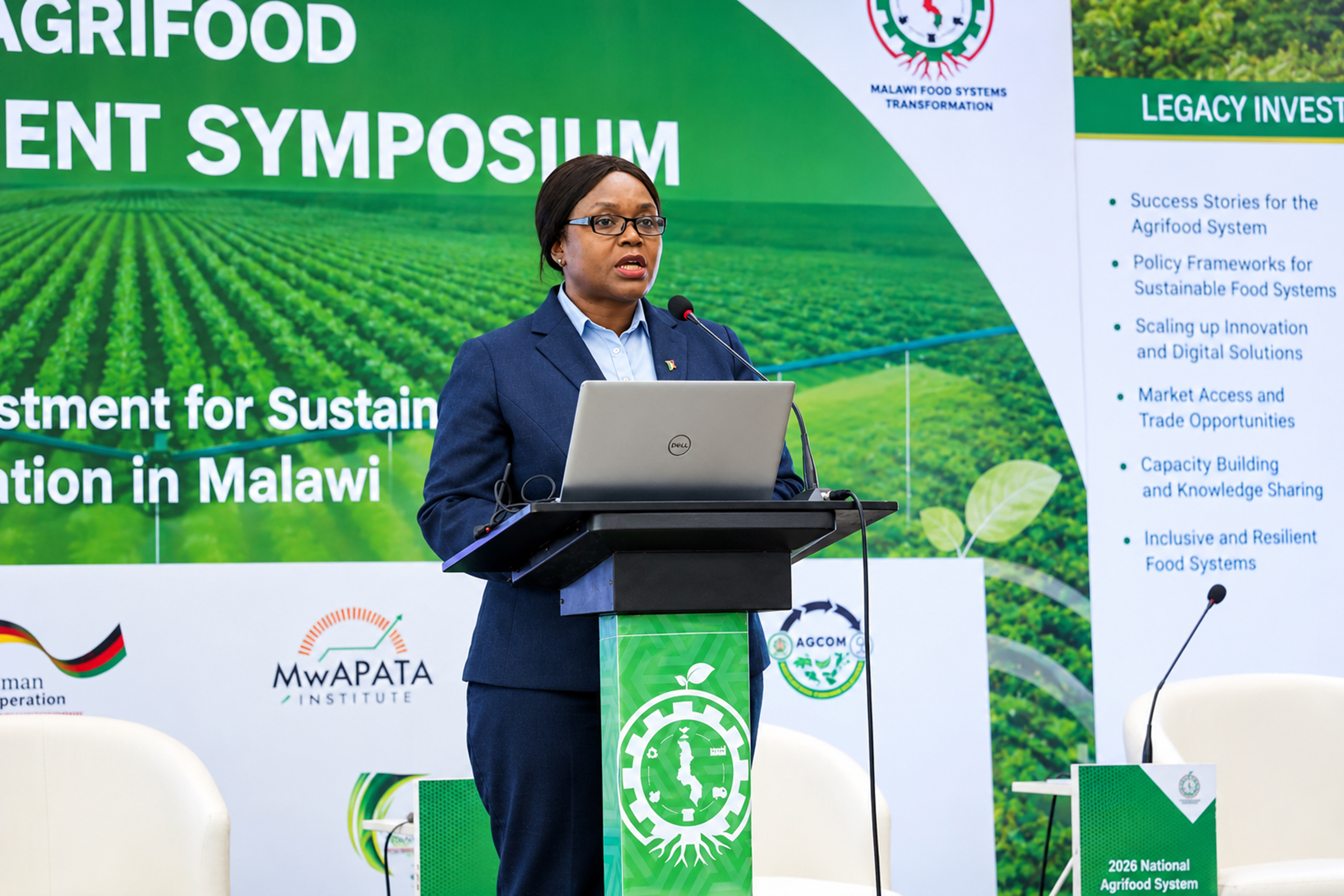
The programme was presented on Monday by Minister of Agriculture, Irrigation and Water Development Roza Fatch Mbilizi during the National Agri-Food Systems Investment Symposium at the Bingu International Convention Centre (BICC) in Lilongwe.
Mbilizi said the programme seeks to place the private sector at the centre of Malawi’s agricultural transformation by creating bankable investment opportunities across priority value chains.
She said Malawi’s youthful population, available labour and supportive policy environment provide a strong foundation for investors to establish and expand agricultural businesses. The programme, she said, represents a shift towards private-sector-led agricultural commercialisation, with Government providing the policy, infrastructure and institutional support necessary to make investments viable and sustainable.
The Minister said the initiative is also designed to address Malawi’s persistent food import bill and the continued export of raw, unprocessed agricultural commodities. While the country has considerable production and export potential, she said gaps in productivity, processing, certification, quality standards and access to premium markets continue to limit the value Malawi derives from its agricultural sector.
“This is a gap. This is an opportunity. What it means is that if you grow maize in this country, there is already a market because there is a gap within the country,” she said.
Mbilizi identified maize, soybean, rice, groundnuts, aquaculture, beef, and honey and bee venom as seven priority value chains offering significant investment opportunities.
She said maize production remains below domestic demand, while substantial opportunities exist to increase soybean production and processing, expand rice production, develop aquaculture and improve the commercialisation of other commodities.
At the centre of the Legacy Investment Programme is the anchor firm model, which is intended to connect large-scale commercial enterprises with smallholder farmers, cooperatives, aggregators, processors, financiers, input suppliers and markets.
Under the model, an anchor firm may operate in production, aggregation or processing while providing structured markets for farmers and creating stronger links across the agricultural value chain. Cooperatives will organise farmers and support the production of commodities that meet the requirements of processors and other businesses.
According to Mbilizi, the model will help create an integrated agricultural ecosystem in which smallholder farmers are connected to commercial markets and assured buyers for their produce.
It is also expected to strengthen traceability, quality control and accountability by linking farmers directly to businesses with clearly defined commodity requirements and standards. “Private-sector leadership is very important. As a government, we are saying it is high time we let the private sector drive this legacy,” she said.
The programme will take investors beyond primary production by promoting value addition across the agricultural value chain, from production and aggregation to processing, wholesale, retail and exports.
Mbilizi said investors will also have opportunities to establish enterprises in Special Agricultural Processing Zones, where infrastructure and other incentives are expected to support competitive agro-processing. The approach is intended to help Malawi retain more value from its agricultural commodities rather than exporting raw produce and importing processed products.
She said government will complement private-sector investment by facilitating the infrastructure and policy environment required for commercial agriculture to thrive. This includes roads, electricity, water, storage facilities and other essential services, with Government working alongside development partners and other stakeholders to support infrastructure development.
Meanwhile, Director General for the Malawi Investment and Trade Centre (MITC), Bisa Namarika, outlined investment incentives and facilitation services available to investors, including tax incentives, investment certification, assistance with land identification, government linkages and other measures aimed at reducing the cost and risks of doing business. He urged investors to engage MITC as a single entry point for investment facilitation and government coordination.
The symposium has provided a platform for Government, the private sector, farmers, development partners and financial institutions to critically identify investment opportunities and practical solutions for transforming Malawi’s agri-food systems.
The programme is aligned with Malawi 2063 and other national agricultural, export and development priorities, with the broader objectives of increasing productivity, creating employment, expanding export earnings, promoting value addition and improving sustainable land management.