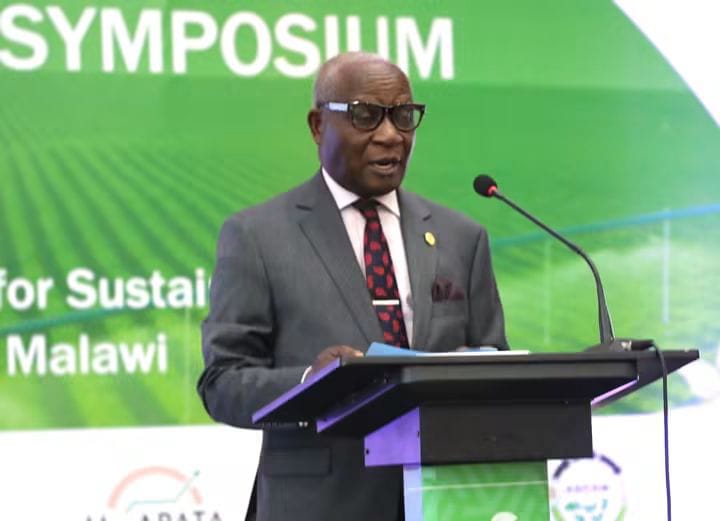
Malawi urged to shift from raw commodity exports to value addition
Minister of Industrialization, Business, Trade and Tourism Simon Itaye has called for increased private-sector investment in agriculture and agro-processing to help Malawi move from primary production to competitive value addition, industrialisation and export growth.
Itaye said the country could no longer afford to export raw agricultural commodities while importing processed products, urging investors to take advantage of opportunities across the agri-food value chain.
He made the remarks on Monday during the National Agri-Food Systems Investment Symposium held at the Bingu International Convention Centre (BICC) in Lilongwe under the theme, “Unlocking Private Sector Investment for Sustainable Agri-Food Systems Transformation in Malawi.”
Itaye said agriculture remained central to Malawi’s economy, contributing between 22 and 30 percent of Gross Domestic Product (GDP), employing about 64 percent of the population and accounting for more than 80 percent of national export earnings.
“Our objective is clear and uncompromising: to build a bridge from primary production to competitive value addition,” We are determined to ensure that every seed planted in Malawian soil yields not just a harvest, but a finished, high-value product destined for domestic, regional and global markets.”
The Minister, however, said the sector continued to face challenges including low productivity, inadequate irrigation and mechanisation, limited access to finance, climate-related shocks, post-harvest losses, weak market linkages and inadequate value addition.
He said addressing these constraints would require significant investment beyond what Government alone could provide, calling for greater participation by domestic and international investors, agribusinesses, financial institutions, technology providers, processors, logistics firms and commercial farmers.
He cited opportunities in processing maize into high-quality flour and industrial products, soybeans into cooking oil and seed cake, groundnuts into peanut butter and mangoes into shelf-stable juice, saying such investments could also increase foreign exchange earnings through exports of processed products.
The Minister challenged the private sector to align investments with the country’s economic transformation agenda under Malawi 2063, saying Government was committed to creating an enabling environment through policy reforms, investment facilitation and improved coordination.
He said the Malawi Investment and Trade Centre (MITC) would continue to facilitate investors by helping them identify opportunities, establish businesses, secure approvals and access export promotion services.
Itaye further said Malawi’s membership in SADC, COMESA and the African Continental Free Trade Area (AfCFTA) provides businesses with access to a market of more than one billion consumers saying the challenge was therefore not a lack of markets, but Malawi’s ability to produce competitively, consistently and at sufficient scale while meeting international quality and standards requirements.
In his remarks, Malawi Confederation of Chambers of Commerce and Industry (MCCI) President Ronald Ngwira said the private sector was ready to invest but Government and other stakeholders needed to urgently address bottlenecks affecting businesses, including foreign exchange shortages, unreliable electricity, high production costs and regulatory delays.
He said Malawi had the ingredients necessary to build a competitive and resilient agri-food system, including fertile soils, labour and water, but needed to connect these resources to investment, processing, markets and supportive policies.
He said MCCI and its members were ready to work with government and other stakeholders to address bottlenecks and build sustainable agri-food systems capable of withstanding climate and economic shocks.